

Cloudways App Hosting: A Deep Dive into Performance, Pricing, and Alternatives
Unlock optimal app performance with a managed cloud hosting solution tailored for your success.
Feeling overwhelmed by the sheer number of hosting options for your web application?
Cloudways promises managed cloud hosting made easy, but does it truly deliver on its hype?
It's time to cut through the marketing jargon and discover if Cloudways is the right fit for your project.
Choosing the right hosting platform is a critical decision for any web application or website, directly impacting performance, security, and scalability. In the crowded market of hosting providers, Cloudways app hosting has carved a significant niche as a managed cloud hosting solution. It offers a unique blend of powerful cloud infrastructure with the ease of use typically associated with traditional shared hosting. This approach aims to simplify the complexities of cloud servers, making high-performance hosting accessible to developers, agencies, and businesses of all sizes.
This comprehensive article will thoroughly evaluate Cloudways' features, performance benchmarks, and pricing models. We’ll delve into its strengths and weaknesses, offering a detailed comparison against prominent competitors like Hostinger, and explore viable alternatives. By the end of this guide, you’ll possess the insights needed to make an informed decision, ensuring you select the most suitable cloud hosting solution for your specific application needs and budget.
Quick navigation
- Understanding Cloudways App Hosting: What It Is
- Key Features and Performance of Cloudways
- Cloudways Pricing: A Value Assessment
- Cloudways vs. Competitors (e.g., Hostinger): A Detailed Look
- Viable Alternatives to Cloudways for App Hosting
- What this means for you
- Risks, trade-offs, and blind spots
- Main points
Understanding Cloudways App Hosting: What It Is
At its core, Cloudways offers a managed hosting platform that bridges the gap between raw Infrastructure as a Service (IaaS) providers and traditional web hosts. Instead of forcing you to choose one cloud provider, Cloudways allows you to deploy your applications on a selection of top-tier cloud infrastructures, including DigitalOcean, Amazon Web Services (AWS), Google Cloud Platform (GCP), Linode, and Vultr. This flexibility is a key differentiator. But what does "managed" truly imply in this context?

Being a managed platform means Cloudways handles the server management, security patching, operating system updates, and overall server health. This eliminates the need for users to possess deep system administration knowledge, a common barrier to entry for many when considering bare cloud servers. You get the power and scalability of cloud infrastructure without the headache of managing it yourself. This approach makes high-performance hosting accessible to a wider audience, from individual developers to marketing agencies and e-commerce businesses.
Think of it this way: Cloudways isn't a cloud provider itself; it's a layer of abstraction and management built on top of existing cloud providers. It takes complex server setup and maintenance tasks and wraps them in a user-friendly interface, allowing you to focus on your applications, not your infrastructure. Is this hands-off approach truly beneficial for your development workflow?
The platform is particularly popular for hosting popular applications such as WordPress, Magento, Laravel, PHP, and custom applications. It provides optimized stacks, dedicated resources, and a suite of tools designed to enhance website speed, security, and development workflows. For those looking for a comprehensive understanding of general hosting concepts, which can help contextualize Cloudways' offerings, you might find this in-depth guide to hosting insightful.
Key Features and Performance of Cloudways
When evaluating Cloudways app hosting, its feature set and performance capabilities are paramount. The platform is designed to provide a robust environment for web applications, focusing on speed, security, and developer-friendly tools. What exactly makes Cloudways stand out in these critical areas?
Optimized Performance Stack
Cloudways prioritizes speed through a carefully engineered "ThunderStack," which includes Nginx, Apache, Varnish, Redis, and Memcached. This combination is optimized to deliver lightning-fast loading times, crucial for user experience and SEO. Additionally, all servers utilize SSD storage, ensuring rapid data access. Users also benefit from built-in content delivery networks (CDNs) and dedicated resources, preventing performance degradation often seen in shared hosting environments.
Robust Security Measures
Security is a cornerstone of Cloudways' offering. The platform provides dedicated firewalls, regular security patching, free SSL certificates for all applications, IP whitelisting, and two-factor authentication for account access. Automated backups are standard, offering peace of mind by ensuring your data is regularly saved and easily restorable. These layers of security are essential for protecting sensitive data and maintaining application integrity.
Developer-Friendly Tools:
- Staging Environments: Easily test changes without affecting your live site.
- Git Integration: Streamline your deployment workflows directly from Git repositories.
- SSH and SFTP Access: Full control over your server files and database.
- One-Click Operations: Simple scaling, application cloning, and server transfers.
- CloudwaysBot: AI-powered smart assistant for server and application monitoring.
Scalability and Reliability
One of the significant advantages of Cloudways is its inherent scalability. You can easily scale your server resources (CPU, RAM, SSD storage) up or down with a few clicks, adapting to fluctuating traffic demands without downtime. This elasticity ensures your application can handle sudden spikes in visitors while only paying for what you use. The choice of multiple cloud providers also adds a layer of reliability, allowing you to select a data center geographically closer to your audience for reduced latency.
Cloudways Pricing: A Value Assessment
Understanding Cloudways app hosting pricing requires a slightly different perspective than traditional hosting. Cloudways operates on a pay-as-you-go model, meaning you only pay for the resources you consume, calculated hourly or monthly. This transparent approach, combined with its tiered plans across various cloud providers, allows for significant flexibility. But what does this mean for your budget, and is it truly cost-effective?
The pricing varies significantly based on two primary factors: the underlying cloud provider you choose (DigitalOcean, Linode, Vultr, AWS, or Google Cloud) and the server specifications (CPU cores, RAM, SSD storage, bandwidth). For instance, a basic DigitalOcean server might start at around $11/month, while a high-tier AWS or Google Cloud server could easily exceed $200-$300/month. This flexibility allows businesses to start small and scale resources as their needs grow, preventing overpayment for unused capacity.
| Cloud Provider | Typical Starting Monthly Price | Key Characteristics | Best For |
|---|---|---|---|
| DigitalOcean | ~$11 - $20 | Budget-friendly, good performance for most apps, developer-focused. | Startups, small websites, personal projects. |
| Linode & Vultr | ~$13 - $25 | Strong performance, good value, more locations than DigitalOcean. | Growing SMBs, e-commerce, high-traffic blogs. |
| AWS & Google Cloud | ~$40 - $70 (starting) | Enterprise-grade reliability, massive scalability, advanced features. | Large enterprises, mission-critical applications, high-compliance needs. |
When assessing value, consider the managed services included. Cloudways handles server patching, security updates, monitoring, and proactive maintenance. If you were to self-manage a cloud server, the time and expertise required would incur significant hidden costs. The platform's 24/7/365 expert support further adds to its value proposition, offering assistance when you need it most. Does the combination of powerful infrastructure and hands-off management justify the price for your specific operational needs?
Cloudways vs. Competitors (e.g., Hostinger): A Detailed Look
To truly understand the positioning of Cloudways app hosting, it's essential to compare it against other popular hosting solutions. Let's pit Cloudways against a competitor like Hostinger, which offers a range of hosting services, from shared to VPS and even its own cloud hosting. What are the key differences that define their value propositions?
| Feature/Aspect | Cloudways App Hosting | Hostinger (Cloud Hosting / VPS) |
|---|---|---|
| Hosting Type | Managed Cloud Hosting (choice of 5 IaaS providers) | Shared, VPS, and proprietary Cloud Hosting (own infrastructure) |
| Ease of Use / Management | Highly managed, intuitive dashboard, one-click actions. Low technical skill needed for server ops. | User-friendly hPanel, good for beginners, but more manual setup for complex apps on VPS. |
| Performance Stack | ThunderStack (Nginx, Apache, Varnish, Redis, Memcached), SSDs, dedicated resources. | LiteSpeed Web Server, SSDs, optimized for speed on their cloud plans. |
| Pricing Model | Pay-as-you-go, hourly billing, varies by cloud provider & resources. | Subscription-based (monthly/yearly), fixed plans, often promotional discounts. |
| Scalability | Seamless horizontal and vertical scaling with a few clicks. | Scalable, but may involve plan upgrades or more manual VPS configuration. |
| Support | 24/7/365 live chat & ticketing with expert cloud engineers. Premium add-ons for dedicated support. | 24/7 live chat, knowledge base. Generally good but might lack deep cloud engineering expertise. |
| Target Audience | Developers, agencies, e-commerce, high-traffic sites seeking performance & flexibility. | Beginners, small businesses, bloggers, budget-conscious users. |
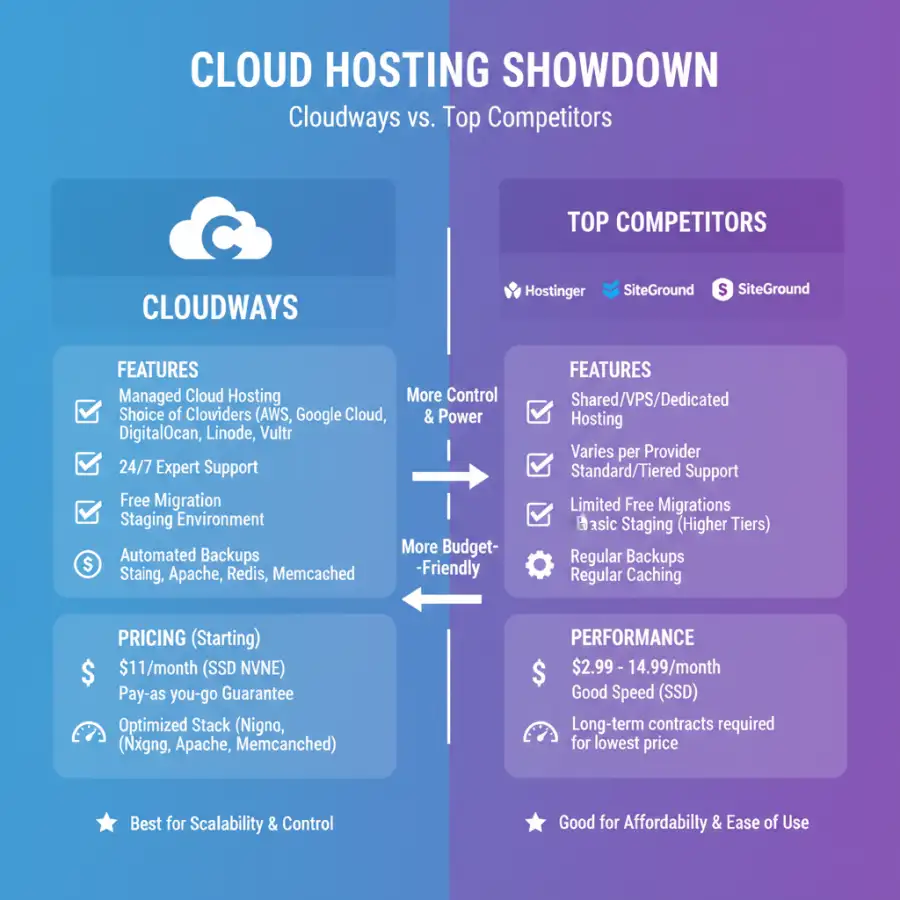
The core difference lies in their philosophy: Cloudways provides a managed layer over enterprise-grade cloud infrastructure, offering flexibility and high performance with simplified management. Hostinger, while offering compelling value, especially for budget-conscious users, provides a more traditional hosting experience with its own cloud infrastructure. For complex or highly scaled applications, Cloudways typically offers more granular control and advanced optimization. What level of server management are you truly comfortable with?
What makes managed cloud hosting different from standard cloud hosting?
Standard cloud hosting, often referred to as IaaS (Infrastructure as a Service), provides you with raw virtual machines. You're responsible for everything from operating system installation and security patches to web server configuration and application deployment. Managed cloud hosting, like Cloudways, adds a layer of service on top. The provider handles the server-level management, freeing you to focus solely on your applications. This distinction is crucial for businesses without dedicated system administrators. For a more general overview of different cloud hosting options and their implications, you might find additional valuable information in this definitive guide to cloud hosting for software.
How can I compare various cloud hosting solutions effectively?
Effective comparison of cloud hosting solutions involves more than just looking at the price tag. Evaluate the provider's uptime guarantees (SLA), the ease of scaling resources, the level of included security features, and the responsiveness and expertise of their customer support. Consider their data center locations for latency and compliance. Read independent reviews and case studies from businesses with similar needs to yours. Understanding your own technical comfort level and resource requirements is also key to narrowing down options. To broaden your understanding of cloud hosting in the context of various applications, you might consider reading this comprehensive article on Sage cloud hosting, which discusses cloud solutions for other popular software.
Viable Alternatives to Cloudways for App Hosting
While Cloudways offers a compelling package for managed Cloudways app hosting, it's not the only option available. Depending on your specific technical expertise, budget, and application requirements, several alternatives might be a better fit. What other platforms should you consider if Cloudways doesn't perfectly align with your needs?
Alternative Hosting Solutions:
- Direct IaaS Providers: For technical users comfortable with server management, direct interaction with DigitalOcean Droplets, AWS EC2, Google Cloud Compute Engine, Linode, or Vultr offers maximum control and potentially lower costs if self-managed efficiently.
- Other Managed WordPress/App Hosts: Kinsta and WP Engine are premium managed WordPress hosts known for exceptional performance and support, albeit at a higher price point. SiteGround and A2 Hosting also offer managed solutions for various applications with good features.
- Traditional VPS Providers: Companies like Vultr, Linode, or even more traditional VPS providers offer virtual private servers. While they require more hands-on management, they provide dedicated resources and more control than shared hosting.
- Shared Hosting (for basic sites): For very small, low-traffic websites or blogs, traditional shared hosting from providers like Bluehost, SiteGround, or Hostinger remains a budget-friendly option, though with significant performance and scalability limitations compared to cloud.
Each alternative comes with its own set of trade-offs regarding cost, management overhead, performance, and scalability. For instance, choosing a direct IaaS provider requires significant technical expertise but offers the most granular control. Conversely, a premium managed WordPress host provides unparalleled ease of use and optimization for WordPress but might be less flexible for custom applications. Your decision should align with your team's capabilities and the specific demands of your application.
What this means for you
Navigating the diverse landscape of app hosting solutions, particularly when considering Cloudways app hosting, ultimately boils down to aligning a platform's capabilities with your specific business and technical requirements. What's the most practical takeaway for your unique situation?
If you're a developer, agency, or small to medium-sized business seeking high performance, robust security, and the flexibility of major cloud infrastructures without the complexity of self-management, Cloudways presents a highly attractive option. Its intuitive control panel and managed services significantly reduce the operational burden, allowing your team to focus on development and growth. The pay-as-you-go model also provides excellent cost control, especially for projects with fluctuating resource needs.
Consider Your Technical Bandwidth: The primary determinant should be your internal technical expertise. If you have experienced system administrators, direct IaaS might be more cost-effective. If your team is lean and focused on application development, the managed services of Cloudways or other specialized hosts offer immense value by offloading infrastructure tasks.
However, if you're launching a very basic blog or small informational website with minimal traffic, Cloudways might be overkill, and a more traditional shared hosting plan or a simple, lower-cost VPS could suffice. Conversely, for large-scale enterprise applications with unique compliance or highly specialized infrastructure needs, direct cloud providers like AWS or GCP might offer a level of customization and control that even Cloudways' managed layer cannot match.
The key is to perform a thorough self-assessment of your technical capabilities, budget, and the current and projected demands of your application. Don't simply chase the lowest price; seek the solution that offers the best blend of performance, manageability, scalability, and support for your long-term success.
Risks, trade-offs, and blind spots
While Cloudways app hosting offers considerable advantages, it's crucial to acknowledge potential risks, inherent trade-offs, and common blind spots before making a final decision. What are the aspects that users sometimes overlook until it's too late?
Cost Creep with Resource Scaling: While the pay-as-you-go model offers flexibility, it can lead to higher costs if not monitored. Scaling resources up too frequently or failing to scale down unused resources can significantly inflate your monthly bill, especially with higher-tier cloud providers like AWS or GCP. Always keep a close eye on your usage and expenses.
A trade-off with any managed service is a slight reduction in direct control. While Cloudways provides SSH access and Git integration, deeply customizing the underlying operating system or installing very specific, non-standard software might be more challenging than with a self-managed server. You're reliant on Cloudways' ecosystem and supported configurations, which might not suit every niche requirement.
Another blind spot can be underestimating the learning curve, even with a managed platform. While Cloudways simplifies server management, understanding concepts like application scaling, advanced caching configurations, and debugging server-side errors still requires some technical aptitude. It's not as completely hands-off as some shared hosting providers, and a basic understanding of cloud principles is beneficial.
Finally, consider the potential for vendor lock-in, albeit softer than with some proprietary platforms. While you can always migrate your application to another host, the ease of doing so might depend on your specific setup and reliance on Cloudways' integrated tools. Always understand their data export policies and the flexibility of moving your applications if your needs change dramatically. Is the convenience worth the potential limitations in extreme customization?
Main points
Making an informed decision about Cloudways app hosting involves weighing its significant advantages against your specific operational context. Here are the crucial takeaways:
- Managed Cloud Power: Cloudways simplifies managed hosting on top of leading IaaS providers (DigitalOcean, AWS, Google Cloud, Linode, Vultr), offering high performance without complex server management.
- Performance-Driven Architecture: Benefit from optimized ThunderStack, SSDs, built-in caching, and dedicated resources for faster application loading and responsiveness.
- Flexible, Transparent Pricing: The pay-as-you-go model offers scalability and cost control, allowing you to pay only for the resources you consume, tailored to your chosen cloud provider.
- Robust Security & Support: Expect dedicated firewalls, free SSL, automated backups, and 24/7/365 expert support, enhancing data protection and issue resolution.
- Developer-Friendly Environment: Tools like staging environments, Git integration, and SSH/SFTP access streamline development and deployment workflows.
- Evaluate Against Competitors: Compare Cloudways' managed approach, performance, and pricing against alternatives like Hostinger (for value) or direct IaaS providers (for control).
- Consider Alternatives: Depending on technical expertise and budget, direct IaaS, other managed app hosts (Kinsta, WP Engine), or traditional VPS providers might be suitable alternatives.
Thoroughly assess your application's needs, your team's technical capabilities, and your budget. By doing so, you can confidently choose the optimal cloud hosting solution, whether it's Cloudways or another platform, to drive your application's success.