
.webp)
Future of Endpoint Security: EDR, XDR, and MDR – Navigating Tomorrow's Cyber Landscape
A comprehensive comparison for understanding advanced threat detection, response, and management in the evolving digital frontier.
The constant battle against cyber threats means static defenses are no longer sufficient. Survival now requires continuous adaptation and proactive security measures.
As digital boundaries disappear and attacks become more complex, choosing the right security strategy – EDR, XDR, or MDR – can seem overwhelming.
This guide clarifies these key technologies, helping your organization not just react to, but anticipate and neutralize tomorrow's cyber threats.
The digital world, while offering convenience and innovation, continually expands the attack surface for malicious actors. From sophisticated ransomware campaigns to elusive nation-state-sponsored intrusions, cyber threats continue to escalate in complexity and volume. In this challenging environment, traditional perimeter-based security models are insufficient, driving a shift toward more intelligent, adaptive, and comprehensive protection. At the heart of this evolution is endpoint security, a field that has rapidly advanced from basic antivirus to specialized detection and response mechanisms.
As organizations grapple with distributed workforces, cloud migrations, and increasingly interconnected systems, understanding the future of endpoint security – especially the distinctions and synergies between Endpoint Detection and Response (EDR), Extended Detection and Response (XDR), and Managed Detection and Response (MDR) – is crucial. This comparison offers a clear guide to these pivotal cybersecurity technologies. We will define their core capabilities, highlight their differences, explore their ideal use cases, and examine how they interact with other critical security tools like SIEM and NDR. By comparing EDR, XDR, and MDR, we will help you determine which solution or combination best fits your organization's unique needs, enabling a robust defense strategy for the evolving cyber landscape.
Quick navigation
- The Foundation: Understanding Endpoint Detection and Response (EDR)
- EDR's Evolution: The Rise of Extended Detection and Response (XDR)
- The Human Element: Managed Detection and Response (MDR)
- Beyond the Acronyms: Interplay with SIEM, NDR, and EPP
- What this means for you
- Risks, trade-offs, and blind spots
- Main points
The Foundation: Understanding Endpoint Detection and Response (EDR)
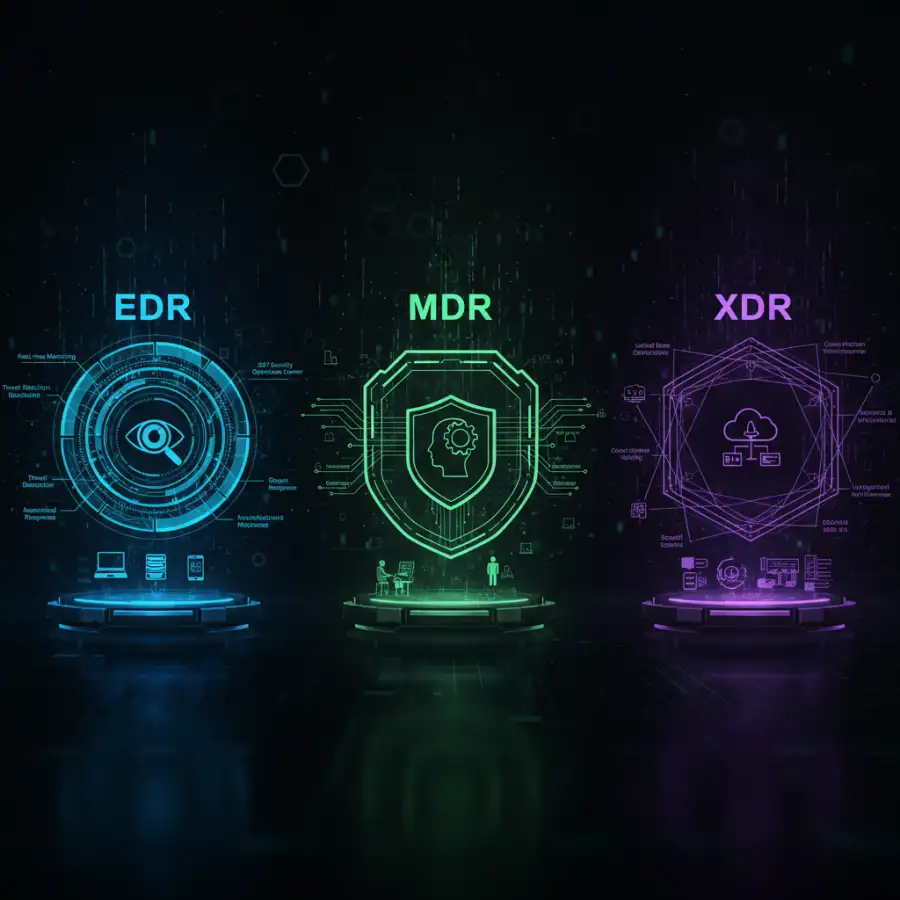
At the heart of modern cybersecurity lies Endpoint Detection and Response (EDR). EDR solutions represent a significant leap beyond traditional antivirus software, shifting the focus from simple prevention to continuous monitoring, detailed data collection, and rapid response at the endpoint level. An endpoint, in this context, refers to any device connected to the corporate network, such as laptops, desktops, servers, tablets, and even mobile phones.

EDR's core capabilities include providing deep visibility into endpoint activity. This includes real-time monitoring of processes, file changes, network connections, and user actions. EDR platforms collect vast amounts of telemetry data from each endpoint, using advanced analytics and machine learning to identify anomalous behavior and potential threats that might bypass traditional preventative measures. When suspicious activity is detected, EDR can provide granular details for investigation, allowing security analysts to understand the scope and nature of an attack. Automated response capabilities often include isolating compromised endpoints, terminating malicious processes, or reverting system changes. EDR equips security teams with the context needed to quickly contain and remediate threats, minimizing dwell time and potential damage. With the vast amount of data generated by endpoints, how can security teams effectively identify threats without being overwhelmed?
EDR's Evolution: The Rise of Extended Detection and Response (XDR)
While EDR provides critical visibility at the endpoint, modern cyberattacks rarely confine themselves to a single device. They often traverse networks, exploit cloud vulnerabilities, target email accounts, and compromise user identities. Recognizing this multifaceted threat landscape, Extended Detection and Response (XDR) emerged as the natural evolution of EDR, aiming to offer a unified, holistic view of an organization's security posture.
XDR expands EDR's capabilities by integrating security telemetry from a much wider array of sources. This includes not only endpoints but also networks, cloud workloads, email systems, identity providers, and more. By correlating data across these diverse domains, XDR platforms can detect more sophisticated attacks that might be missed by siloed security tools. It moves beyond just detecting individual suspicious events to constructing a complete narrative of an attack, revealing lateral movement, command and control communications, and data exfiltration attempts. This improved threat visibility leads to faster root cause analysis, reduced alert fatigue, and more efficient incident response. While XDR promises a more cohesive security fabric, deploying XDR often means consolidating multiple vendor solutions or committing to a single vendor's ecosystem. This can create integration challenges, especially for organizations with existing, disparate security systems. Managing complex IT operations and security data is key to making these systems effective. Can a single platform truly protect across every digital frontier, or do even broad XDR solutions have limitations?
The Human Element: Managed Detection and Response (MDR)
Even with advanced technological solutions like EDR and XDR, the sheer volume and sophistication of cyber threats can overwhelm in-house security teams, particularly for organizations lacking dedicated security operations centers (SOCs) or specialized threat hunters. This is where Managed Detection and Response (MDR) services step in, offering a critical human element to the cybersecurity equation.
MDR is essentially an outsourced security service where a third-party provider offers 24/7 monitoring, proactive threat hunting, and rapid incident response capabilities. Unlike simply providing a security tool, MDR services involve a team of expert analysts who use EDR, XDR, and other security technologies to actively search for, investigate, and respond to threats on behalf of their clients. This means organizations benefit from continuous vigilance and specialized expertise without the significant investment in building and staffing their own SOC. MDR providers often bring advanced threat intelligence, proprietary hunting techniques, and established incident response playbooks to the table, allowing for faster and more effective containment of breaches.
MDR's primary appeal is its ability to bridge the cybersecurity skills gap and provide robust, around-the-clock protection. Organizations can reduce the burden on their internal IT teams, allowing them to focus on core business operations. However, the trade-off typically involves a significant recurring cost and a degree of relinquishing direct control over security operations. A thorough cost-benefit analysis is crucial to determine if MDR aligns with an organization's budget and strategic security objectives. Given the ongoing shortage of skilled cybersecurity professionals, is outsourcing your entire threat detection and response the most sustainable long-term solution?
Beyond the Acronyms: Interplay with SIEM, NDR, and EPP
The cybersecurity landscape is full of acronyms, and EDR, XDR, and MDR don't operate in isolation. Understanding how they interact with other established and emerging security technologies like Security Information and Event Management (SIEM), Network Detection and Response (NDR), and Endpoint Protection Platforms (EPP) is key to building a truly resilient defense.
An Endpoint Protection Platform (EPP) provides traditional frontline defense. This includes antivirus, anti-malware, and host-based firewalls, focusing primarily on preventing known threats. EDR evolved from EPP, adding detection, investigation, and response capabilities for unknown and advanced threats. Think of EPP as the guard at the gate, while EDR acts as the security camera and rapid response team inside.
SIEM systems gather data from nearly all security tools, network devices, applications, and operating systems, offering a broad overview. This broad overview extends to various business applications, including modern solutions like SaaS accounting services, which are increasingly central to an organization's operations. While powerful for compliance and detecting known attack patterns, SIEMs can produce many alerts and often need significant expertise to manage. They are broad but can be reactive. In contrast, XDR uses similar data sources but focuses more on real-time threat detection and response by correlating specific security events across domains, aiming for faster, more actionable insights than a traditional SIEM.
Network Detection and Response (NDR), as the name suggests, focuses on network traffic. It uses machine learning and behavioral analytics to detect anomalous activity, lateral movement, and command and control communications within the network itself. NDR complements EDR and XDR by providing crucial visibility into network-based threats that might bypass endpoint controls. Together, EDR, XDR, SIEM, and NDR form layers of a comprehensive defense, each contributing unique visibility and detection capabilities. When building a multi-layered defense, how can you ensure these different technologies communicate effectively to create a unified security posture?

What this means for you
For organizational leaders or IT professionals, navigating EDR, XDR, and MDR means making strategic decisions that directly impact resilience against cyberattacks. This isn't about adopting every new technology; it's about building a coherent, effective security strategy aligned with your organization's unique threat landscape, resources, and compliance requirements.
If your organization has a robust, skilled in-house security team and primarily needs deep visibility into endpoint activities, a standalone EDR solution might be a powerful asset. It equips your team with tools for proactive threat hunting and rapid incident response. However, if your threat surface extends across endpoints, networks, clouds, and email, and you seek a more integrated, cross-domain approach, XDR offers a compelling path towards consolidated threat detection and faster investigations. This can significantly reduce alert fatigue and improve the efficiency of your security analysts. For organizations facing a shortage of cybersecurity talent, or those that prefer to offload the burden of 24/7 monitoring, threat hunting, and incident response to experts, MDR services provide a robust, human-driven solution. Ultimately, the best strategy often involves a layered approach, carefully integrating these solutions with your existing EPP, SIEM, and NDR capabilities. How can you ensure your chosen security architecture not only blocks known threats but also anticipates tomorrow's unknown challenges?
Risks, trade-offs, and blind spots
While EDR, XDR, and MDR promise enhanced security, implementing and managing these advanced solutions involves inherent risks, trade-offs, and potential blind spots requiring careful consideration. Overlooking these can lead to operational inefficiencies, unexpected costs, or a false sense of security.
One common risk, particularly with EDR and XDR, is alert fatigue. The sheer volume of telemetry data can overwhelm security analysts if tools aren't properly tuned or if the team lacks expertise to triage alerts effectively. This can lead to critical threats being missed amidst the noise. Another significant trade-off, especially for XDR, can be vendor lock-in. Committing to a single vendor's XDR platform offers deep integration but might limit flexibility to choose best-of-breed components from other providers later. Integrating XDR with existing, disparate security tools can also be a complex and time-consuming challenge.
For MDR, the main trade-off is often cost; outsourcing security operations is a significant investment. Organizations must also be comfortable relinquishing a degree of direct control over their security incident response processes. A common blind spot across all these solutions is the "silver bullet" fallacy – the mistaken belief that simply deploying an advanced technology will solve all cybersecurity problems. No single solution is perfect; human expertise, continuous training, robust processes, and ongoing threat intelligence are equally vital. Furthermore, neglecting foundational security hygiene (like patching and strong authentication) can render even advanced EDR/XDR/MDR solutions almost ineffective. Mastering complex software solutions, especially those central to your operational security, requires continuous learning and adaptation, much like mastering an advanced SaaS platform for financial management. In the pursuit of advanced cyber defenses, what subtle but critical factors could inadvertently create new vulnerabilities or undermine your overall security posture?
Main points
- Endpoint Detection and Response (EDR) provides deep, real-time visibility and response capabilities at the individual device level, moving beyond traditional prevention.
- Extended Detection and Response (XDR) builds on EDR, integrating security data from endpoints, networks, cloud, email, and identity for holistic threat detection and faster investigations.
- Managed Detection and Response (MDR) offers outsourced 24/7 security operations, leveraging human expertise for proactive threat hunting and rapid incident response, bridging internal skill gaps.
- These advanced solutions complement, rather than replace, other critical security tools like Endpoint Protection Platforms (EPP), Security Information and Event Management (SIEM), and Network Detection and Response (NDR).
- Choosing the right solution requires a careful assessment of an organization's specific threat landscape, available in-house resources, budget, and desired level of security control.
- Key risks and trade-offs include potential alert fatigue, vendor lock-in with XDR, the cost of MDR services, and the crucial need for ongoing human expertise and proper tool tuning.
- No single technology is a silver bullet; a truly effective cybersecurity strategy combines advanced tools with foundational hygiene, skilled personnel, and continuous adaptation.
- The future of endpoint security involves a highly integrated, intelligent, and often human-assisted approach to detecting and responding to increasingly sophisticated and distributed cyber threats.
Equip your organization for future cyber challenges. Understand these critical distinctions to build a resilient and adaptive security framework for tomorrow's digital world.