

Mastering the Cloud: A Comparison of Leading SaaS Software Asset Management Platforms
From identifying shadow IT to optimizing spend, gain strategic control over your SaaS ecosystem.
Are you losing control of your SaaS subscriptions, with costs escalating and security risks mounting? Discover how a dedicated management platform can bring order to your cloud chaos.
Imagine having a single pane of glass to view, manage, and optimize every SaaS application across your organization. Learn how leading solutions make this powerful visibility a reality.
The right **SaaS Software Asset Management** tool isn't just about saving money; it's about strategic control and operational excellence. Explore a comparison of the platforms poised to transform your digital ecosystem.
The widespread use of Software as a Service (SaaS) applications has profoundly transformed modern business, offering unparalleled agility and collaborative potential. However, this ease of adoption has also brought new complexities: unchecked SaaS sprawl, hidden costs, security vulnerabilities, and compliance headaches. When not managed effectively, these challenges can severely undermine an organization's efficiency and financial health. This is where dedicated SaaS Software Asset Management (SAM) software becomes indispensable. Far more than simple inventory tracking, these platforms provide comprehensive oversight, from discovery and usage monitoring to cost optimization and risk mitigation. This in-depth guide will compare leading SaaS SAM solutions, examining their core functionalities, evaluating their pricing models, and highlighting key considerations to help you select the ideal platform to centralize control, optimize spend, and secure your cloud-based operations.
Quick navigation
The Imperative for SaaS Software Asset Management
In the digital-first era, SaaS applications are the engines driving business operations, collaboration, and innovation. From project management tools to CRM systems and communication platforms, the average organization now relies on hundreds, if not thousands, of cloud-based subscriptions. This proliferation, while enabling unprecedented agility, has also created a new frontier for IT and finance challenges, making the imperative for dedicated SaaS Software Asset Management (SAM) clearer than ever.

The primary driver for robust SaaS SAM is the unchecked growth known as "SaaS sprawl" or "shadow IT." Individual departments or employees, eager for solutions, often sign up for new cloud services without central IT's knowledge or approval. This leads to a fragmented, invisible software landscape where multiple applications perform redundant functions, licenses are over-purchased, and critical data is stored in unapproved, potentially insecure locations. The direct consequences are alarming: significant **cost overruns** due to unused or underutilized subscriptions, often referred to as "cloud shelfware." Estimates suggest that a substantial portion of SaaS spend is wasted annually, a silent drain on the budget. Industry analyses frequently highlight that companies often waste 30% or more of their annual SaaS budget on subscriptions that are either completely unused, underutilized, or redundant. This wastage represents a significant, yet often overlooked, opportunity for cost recovery and budget reallocation, demonstrating the clear financial benefits of a robust SAM strategy.
Beyond costs, the lack of central oversight creates profound **security vulnerabilities**. Each unmanaged SaaS application represents a potential entry point for cyber threats, a risk of data breaches, and a compliance nightmare. Without a clear inventory, enforcing consistent security policies, managing user access, and ensuring data residency become virtually impossible. Furthermore, businesses face mounting **compliance risks** with evolving data protection regulations (e.g., GDPR, CCPA). Demonstrating adherence to these standards requires comprehensive visibility and control over all software assets, a task rendered impossible by fragmented management. Is the promise of cloud agility quietly giving way to unseen operational and financial liabilities?
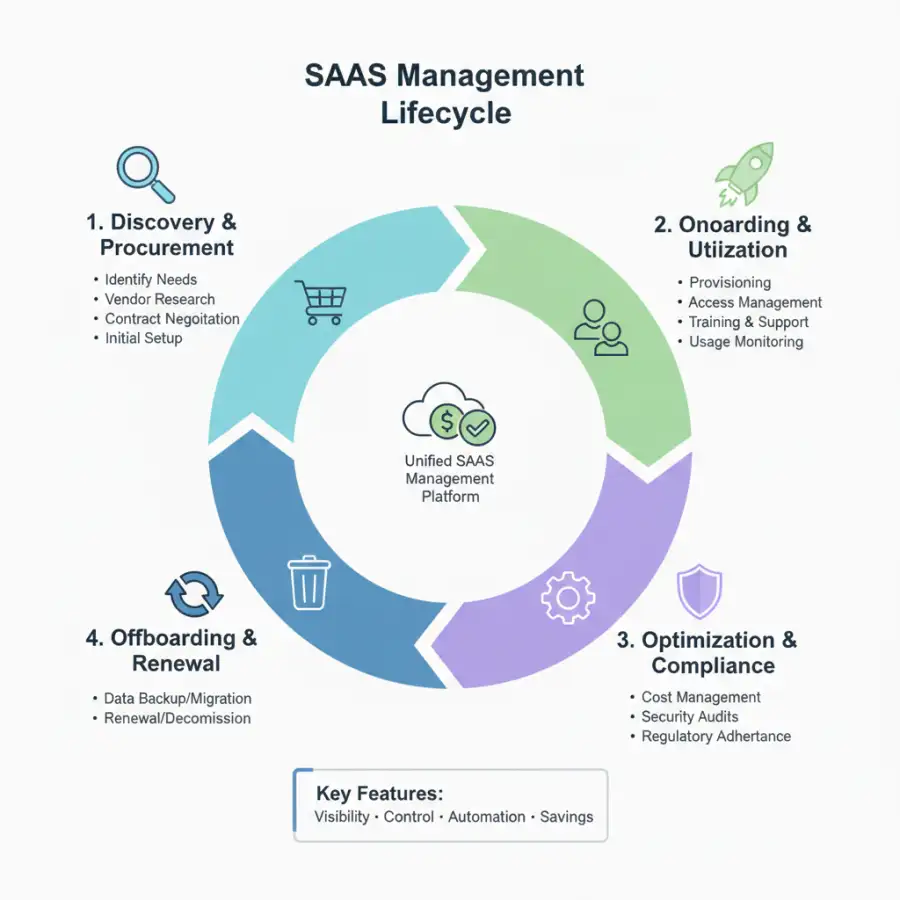
Effective SaaS SAM directly addresses these critical pain points. It provides the necessary visibility to identify all applications, users, and usage patterns. It enables organizations to optimize spend by identifying and reharvesting unused licenses, negotiating better terms, and streamlining procurement. This leads to immediate and measurable financial returns, turning a previous expenditure into a strategic investment. Crucially, it strengthens the security posture by bringing shadow IT under control, enforcing access policies, and ensuring data protection across the entire SaaS ecosystem. In essence, SaaS SAM transforms cloud chaos into a strategically managed environment, ensuring that every dollar spent on software delivers maximum value and every application operates securely.
Core Features: What to Demand from Your SaaS SAM Platform
When choosing a SaaS Software Asset Management (SAM) platform, it's crucial to look beyond surface-level promises and evaluate the depth and breadth of its core features. A truly robust solution will offer a comprehensive set of functionalities designed to provide granular control and actionable insights across your entire SaaS estate. Knowing what to demand ensures you invest in a tool that genuinely solves your organization's unique challenges.
The cornerstone of any effective SAM tool is **Automated Discovery and Inventory**. This feature should autonomously identify all SaaS applications in use across your organization, irrespective of how they were acquired. This often involves integrating with Single Sign-On (SSO) providers, analyzing network traffic, expense reports, and email metadata, and potentially utilizing browser extensions to uncover "shadow IT." Advanced platforms can even detect trial versions or free accounts that could later become significant liabilities. Once discovered, the platform must build a real-time, centralized inventory of applications, their associated users, and relevant contract details. Without this foundational visibility, effective management is impossible. What specific capabilities transform a basic tracking tool into a strategic management hub for your cloud assets?
**Usage Tracking and Optimization** is where the rubber meets the road for cost savings. The software must monitor actual user activity and feature utilization within each SaaS application. This granular data allows you to identify unused licenses, underutilized subscriptions, and redundant applications. With these insights, you can confidently downgrade to lower tiers, reharvest licenses from inactive users, or eliminate unnecessary services, directly reducing "cloud shelfware" waste. Closely related is **Cost Management**, which centralizes all SaaS spend data, including subscription fees, renewal dates, and contract terms. This provides a clear financial overview, enables proactive renewal management, and facilitates better negotiation with vendors, ensuring you always get the best value. By understanding historical spend and current utilization, organizations can predict future needs more accurately and avoid costly auto-renewals for services no longer required.
**Security and Compliance Monitoring** are paramount in today's regulatory landscape. A strong SAM platform should audit access, permissions, and data exposure across all applications, flagging potential security risks or policy violations. It helps enforce internal security policies and ensures adherence to external regulatory requirements by providing clear audit trails. Furthermore, **Lifecycle Management** streamlines the entire journey of a SaaS application: from initial procurement and seamless onboarding of new users to managing access changes and efficiently offboarding departing employees. This automation minimizes manual effort, reduces human error, and significantly enhances your security posture. For organizations that need to tightly integrate their financial records with their SaaS spend, strong integration with accounting services is vital. A deep dive into a complete guide to SaaS accounting services can further illustrate the importance of this integration for accurate budgeting and financial oversight. Finally, robust **Integration Capabilities** with existing SSO, HRIS, and ITSM platforms, alongside comprehensive **Reporting and Analytics** with customizable dashboards, provide the holistic view and actionable intelligence needed for strategic decision-making.
Leading SaaS SAM Solutions: A Comparative Overview
The market for **SaaS Software Asset Management (SAM)** solutions is dynamic and competitive, with several platforms offering distinct strengths tailored to different organizational needs and sizes. A comparative understanding of these leading contenders is essential for making an informed purchasing decision.
Zylo: The Enterprise-Focused Optimizer
Zylo is a prominent player, particularly for larger enterprises with extensive SaaS portfolios. Its strength lies in its sophisticated discovery engine, which uses direct integrations, browser extensions, and financial data to provide an unparalleled view of all SaaS applications. Zylo excels at **optimizing spend**, offering deep insights into contract terms, renewal dates, and opportunities for cost reduction through negotiation or license reclamation. It provides robust **usage intelligence**, allowing organizations to understand actual feature adoption and identify underutilized licenses. While powerful, Zylo's comprehensive feature set and pricing structure are typically geared towards organizations with significant SaaS spend and complex management requirements, making it a strong fit for large-scale enterprise deployments.
Torii: The Lifecycle Management Powerhouse
Torii positions itself as a complete SaaS management platform, focusing on automated lifecycle management from discovery to deprovisioning. Its key differentiators include strong **workflow automation** capabilities for onboarding and offboarding, ensuring that user access is provisioned and revoked efficiently and securely. Torii also offers excellent **security and compliance** features, allowing IT teams to monitor app permissions, detect shadow IT, and enforce security policies. It provides good visibility into usage and spend, making it a strong choice for organizations prioritizing automation and security across the entire SaaS user journey. Its emphasis on automated lifecycle management simplifies complex administrative tasks, ensuring a more secure and streamlined process from initial acquisition to offboarding. Torii is particularly adept at integrating with various IT and HR systems to automate user access adjustments.
Blissfully (now part of Flexera): The Collaboration Enabler
Blissfully (now integrated into Flexera's offerings) focused on a collaborative approach to SaaS management. It provided a centralized directory of all SaaS apps, allowing different departments to manage their subscriptions while maintaining IT oversight. Its strengths included clear **ownership tracking** for applications, streamlined **vendor management** (including contract and renewal tracking), and robust **employee lifecycle automation** for rapid onboarding and offboarding. Blissfully was particularly useful for organizations seeking a balance between centralized control and departmental autonomy in SaaS procurement and management. Although now integrated with Flexera, its collaborative approach to managing SaaS applications continues to influence best practices in the field, emphasizing shared ownership and visibility.
BetterCloud: The Ops & Security Orchestrator
BetterCloud, while offering comprehensive SaaS management, has a strong emphasis on **SaaS Operations (SaaSOps)** and **security automation**. Its platform allows IT teams to manage user access, configure security policies, and automate operational workflows across multiple SaaS applications from a single console. This focus makes it highly beneficial for organizations prioritizing security enforcement, compliance, and streamlined IT operations within their cloud environment. BetterCloud's ability to orchestrate actions across disparate SaaS apps is a key differentiator, helping to automate critical tasks and enforce consistent policies. Its strength lies in automating complex, multi-application workflows, which significantly reduces manual effort and enhances overall security posture. This allows IT to maintain robust governance across a diverse range of SaaS tools. Among these platforms, which one truly provides the comprehensive oversight needed to transform your diverse SaaS landscape into a unified, strategic asset?
Each of these leading solutions brings unique strengths to the table, and the "best" choice will ultimately depend on your organization's size, complexity of SaaS usage, budget, and primary management goals, whether that's cost optimization, security, automation, or a blend of all three.
Beyond Features: Pricing Models & Scalability Considerations
While the feature set of a SaaS Software Asset Management (SAM) platform is paramount, the ultimate purchasing decision often boils down to its pricing model and how well it scales with your organization's growth. Grasping these financial and strategic considerations is crucial for a sustainable long-term investment.
Most SaaS SAM solutions operate on a **subscription-based pricing model**, typically charged monthly or annually. However, the basis for this pricing can vary significantly. Common models include: **per user**, **per application**, **per managed asset/instance**, or **tiered pricing** based on the number of employees or the total SaaS spend being managed. For instance, a platform might charge per active user per month, or offer tiers that include a certain number of applications or a specific range of annual SaaS expenditure. It's vital to dissect these models to understand what's included in each tier and to anticipate how costs will escalate as your organization grows. Always look for potential hidden fees, such as additional charges for premium integrations, advanced reporting modules, or exceeding data storage limits. Some platforms might also charge for support beyond basic tiers, which can add up. Is the initial price tag truly indicative of the long-term investment, or are there hidden costs that could impact your budget?
**Scalability** is another non-negotiable factor. As your business expands, your SaaS footprint will inevitably grow. Can the chosen SAM software gracefully accommodate an increasing number of applications, users, and more complex workflows without requiring a complete system overhaul? Platforms designed for enterprise clients, like Zylo or Flexera (which now includes Blissfully), are built with high scalability in mind, capable of managing thousands of applications and users. Smaller, more affordable solutions might have limitations that necessitate migration to a different platform down the line, leading to costly and disruptive transitions. Choosing a solution that can grow with your organization helps avoid the significant time and financial overhead associated with migrating to a new system when your needs evolve. A scalable platform ensures that your investment continues to deliver value as your business matures. When considering a significant investment like a SaaS SAM solution, a thorough financial analysis is imperative. Resources like The ROI Revolution: Cost-Benefit Analysis for Software Implementation can provide a structured framework to evaluate whether a higher initial investment in a highly scalable and feature-rich platform ultimately delivers greater returns and efficiencies over time, justifying the expense.
Furthermore, consider **implementation costs** and the availability of **free trials or demo accounts**. While the software subscription is the main ongoing cost, initial setup, data migration, and employee training can add to the total investment. Many vendors offer free trials, which are invaluable for testing the platform's usability and feature set within your specific environment before committing financially. This hands-on experience allows you to assess the actual value proposition and ensure a smooth rollout. Ultimately, the best SaaS SAM solution provides a transparent pricing model that aligns with your budget while offering the necessary scalability to support your business's future growth without unexpected financial surprises.
What this means for you
For you, the proactive IT leader, finance manager, or business owner, adopting a robust SaaS Software Asset Management (SAM) platform means converting a potentially chaotic, costly, and risky cloud environment into a strategically managed asset. It translates directly into tangible benefits that impact your bottom line and operational resilience.
This comprehensive visibility enables you to significantly optimize costs by identifying and eliminating unused or redundant licenses, right-sizing subscriptions to actual usage, and using accurate data for powerful vendor negotiations. This directly frees up valuable budget for other strategic initiatives. More critically, a well-implemented SaaS SAM strategy dramatically improves your security posture. By bringing shadow IT into the light, enforcing consistent access policies, and automating user provisioning/deprovisioning, you minimize attack surfaces and mitigate the risk of data breaches. This proactive approach to security helps protect sensitive company data and intellectual property. Furthermore, you achieve demonstrable **compliance** with regulatory requirements, avoiding hefty fines and protecting your organization's reputation. This isn't just about managing software; it's about gaining strategic control over your entire digital ecosystem. This newfound clarity and efficiency allow your teams to focus on innovation and core business objectives, rather than being bogged down by administrative overhead, ultimately advancing your business with confidence and agility. How will gaining strategic control over your SaaS landscape fundamentally redefine your approach to cloud operations and financial stewardship?
Risks, trade-offs, and blind spots
While the promise of streamlined operations and cost savings with SaaS Software Asset Management (SAM) is compelling, it's essential to approach implementation with a realistic understanding of the potential risks, trade-offs, and common blind spots. Overlooking these challenges can undermine even the most well-intentioned SAM initiatives, turning a promising investment into a source of frustration.
One significant risk lies in **implementation complexity**. Integrating a comprehensive SAM platform with your existing Single Sign-On (SSO), HR, and accounting systems, along with configuring discovery mechanisms, can be a time-consuming and resource-intensive endeavor. This often requires dedicated project management, internal IT resources, and potentially external consulting expertise to ensure a seamless rollout and integration with your unique technological stack. The initial setup phase can be a significant hurdle if not adequately planned. A common blind spot is **user adoption**. Even the most feature-rich software will fail if employees resist using it. Inadequate training, a lack of clear communication regarding its benefits, or a failure to involve key stakeholders early on can lead to low adoption rates, rendering the investment ineffective. This resistance often stems from a perception that SAM is an additional burden rather than a benefit, highlighting the need for strong change management. What hidden complexities or subtle compromises might exist beneath the surface of a seemingly perfect cloud management solution?
There's also a delicate **trade-off between customization and simplicity**. While many SAM platforms offer extensive configuration options, the temptation to over-customize every single field and workflow can lead to an overly complex system that becomes difficult to manage, update, and scale. Conversely, choosing an overly simplistic solution might leave you wanting for advanced features as your business grows. The issue of **vendor lock-in** is another critical consideration; once your organization's critical SaaS data and workflows are deeply integrated within a specific SAM platform, migrating to an alternative provider can be a daunting, costly, and disruptive process. This underscores the need for thorough due diligence in vendor selection, focusing on data portability and long-term flexibility.
**Data privacy and security concerns** are paramount. By centralizing information about all your SaaS applications and their usage, you are entrusting a significant amount of sensitive organizational data to the SAM tool itself. Rigorously vetting the SAM vendor's security protocols, data encryption practices, and compliance certifications is non-negotiable. Finally, be wary of **"feature bloat"** – paying for a premium tier that includes numerous advanced features you neither need nor use, which directly impacts your ROI. This over-provisioning can inflate costs and complicate platform usage, counteracting the very efficiency gains a SAM solution aims to provide. Carefully assess your current and foreseeable needs to avoid unnecessary expenditure. For organizations managing particularly complex or enterprise-level SaaS environments, understanding the intricacies of systems like mastering Sage Intacct SaaS can highlight the scale of challenges that even advanced SAM tools might face, demonstrating that no solution is without its nuances when dealing with highly specialized or integrated software landscapes.
Main points
- SaaS Software Asset Management (SAM) is essential for modern businesses to combat sprawl, optimize costs, enhance security, and ensure compliance across cloud applications.
- Key features of robust SAM software include automated discovery and inventory, granular usage tracking, centralized cost management, and strong security and compliance monitoring.
- Leading platforms like Zylo (enterprise-focused), Torii (lifecycle automation), and BetterCloud (security orchestration) offer distinct strengths to meet varying organizational needs.
- Evaluate pricing models based on users, applications, or assets, and critically assess a platform's scalability to ensure it supports long-term growth without unexpected costs.
- Successful SAM implementation translates to significant cost savings, a fortified security posture, enhanced operational efficiency, and data-driven decision-making.
- Be aware of risks such as implementation complexity, potential user adoption challenges, vendor lock-in, data privacy concerns, and the trade-off between customization and simplicity.
- Thoroughly vet SAM vendors, leverage free trials, and foster a culture of awareness among employees to ensure a smooth and effective transition to managed SaaS.
- The ideal SaaS SAM solution provides a single pane of glass for comprehensive visibility and control, transforming your cloud investments into a powerful strategic advantage.
Take strategic control of your SaaS ecosystem today. Explore these leading Software Asset Management platforms and make an informed decision that drives efficiency, security, and sustained growth for your organization.