
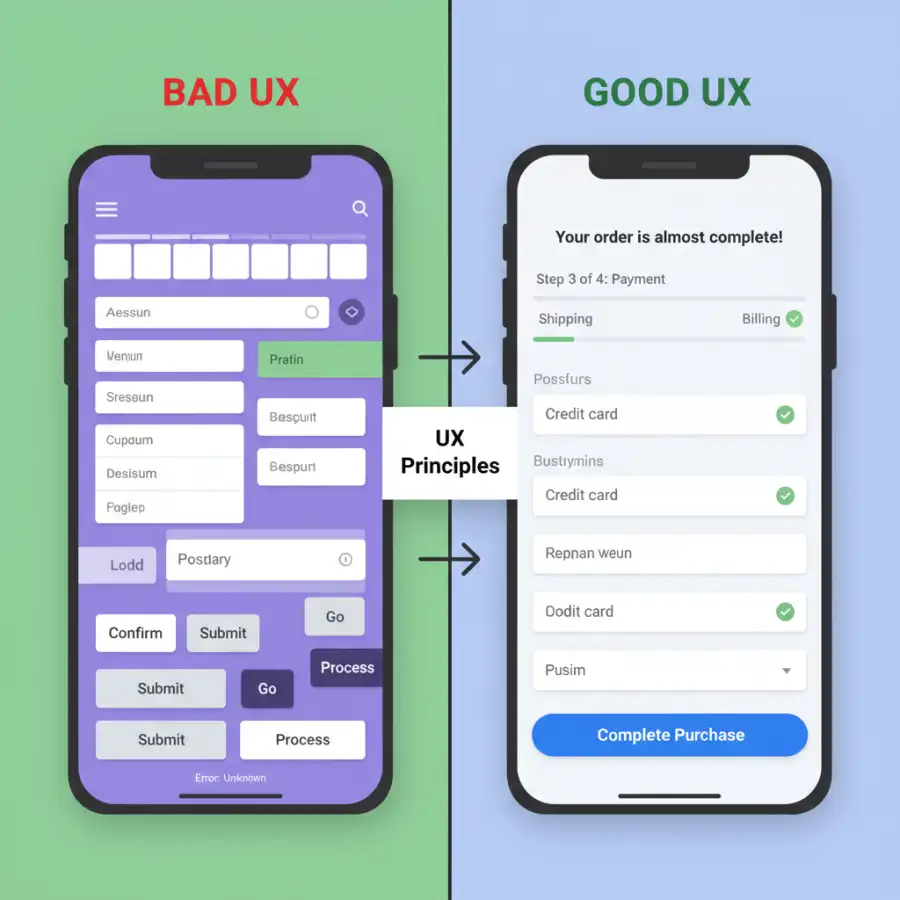
Mastering Digital Interaction: UX Principles Explained for FinanceTech Success
Crafting Intuitive, Trustworthy, and Engaging User Experiences in a Complex Financial World
Ever found yourself effortlessly navigating a financial app, completing complex tasks with surprising ease? That's not magic, it's the quiet power of meticulously applied UX principles at work.
In a world where digital trust is paramount, how do companies ensure their platforms feel secure, simple, and utterly indispensable? The answer lies in understanding the human element of design.
From depositing a check with a tap to managing intricate investments, the success of modern FinanceTech hinges on more than just robust features; it's about the invisible architecture of a flawless user experience.
In today's digital landscape, where every tap, swipe, and click shapes our interactions, User Experience (UX) design has become a cornerstone of product success. It's particularly vital in sectors like FinanceTech, where the stakes are high, and user trust is non-negotiable. UX isn't just about making an app look pretty; it's a comprehensive discipline focused on making products useful, usable, and desirable for the people who interact with them. In financial services, this means crafting digital interfaces that instill confidence, simplify complex processes, and reduce the anxiety often associated with money management.
A well-designed UX can be the differentiator between a beloved financial application and one quickly abandoned. It translates into real-world benefits: increased customer adoption, fewer errors, and a stronger sense of security. This guide aims to provide a clear look at the foundational UX Principles Explained, exploring not just what they are, but how they are strategically applied within the intricate world of FinanceTech. We'll unpack the core philosophies, explore practical examples, and even touch upon the psychological underpinnings that make certain designs resonate with users, ultimately shaping a more intuitive and trustworthy financial future.
Quick navigation
- The Core Philosophy of User Experience Design: Beyond Aesthetics
- Fundamental UX Principles Explained: Guiding the User Journey
- Applying UX Principles in FinanceTech: Real-World Examples
- The Psychology Behind Great UX: Understanding User Behavior
- What this means for you
- Risks, trade-offs, and blind spots
- Main points
The Core Philosophy of User Experience Design: Beyond Aesthetics
User Experience (UX) design, at its heart, is a human-centered approach to product development. It encompasses every interaction a user has with a product or service, from the initial discovery to the final engagement. Unlike User Interface (UI) design, which focuses specifically on the visual and interactive elements of a product (the buttons, sliders, text fields), UX design examines the underlying structure, functionality, and overall journey a user undertakes. It's about understanding user needs, behaviors, and motivations to create an experience that is not only visually appealing but also efficient, effective, and emotionally satisfying.
The core philosophy of UX emphasizes empathy. Designers must step into the shoes of their users, anticipating their needs, frustrations, and desires. This involves extensive research, including user interviews, usability testing, and data analysis, to truly grasp the context in which a product will be used. For FinanceTech, this means understanding how people manage their money, their concerns about security, their financial goals, and their digital literacy levels. A good UX designer isn't just solving a technical problem; they're solving a human problem. They are creating meaningful, relevant experiences that reduce cognitive load, prevent errors, and build confidence. Why is a beautiful interface meaningless if a user cannot achieve their goal?
Ultimately, UX design aims to optimize the entire journey. It's about ensuring that a user can accomplish their tasks seamlessly and pleasurably, fostering a sense of accomplishment rather than frustration. This holistic perspective moves beyond mere aesthetics to focus on functionality, accessibility, and the emotional impact of the interaction. In the competitive FinanceTech landscape, where trust and clarity are paramount, a superior UX can be the decisive factor in attracting and retaining customers, transforming complex financial operations into intuitive and empowering experiences.
Fundamental UX Principles Explained: Guiding the User Journey
While UX design is a broad field, it is underpinned by a set of universal principles and heuristics that guide designers in creating effective and user-friendly products. These principles, often derived from decades of human-computer interaction research, serve as a checklist for evaluating and improving any digital experience. Jakob Nielsen's 10 Usability Heuristics are among the most widely recognized, offering a robust framework. Let's explore some of these fundamental UX principles and their general application:
- Visibility of System Status: Users need to know what's happening. The system should always keep users informed about what is going on, through appropriate feedback within reasonable time. Think of loading spinners, progress bars during file uploads, or confirmation messages after an action. This principle builds trust and reduces uncertainty.
- Match Between System and Real World: The system should speak the users' language, with words, phrases, and concepts familiar to the user, rather than system-oriented terms. Follow real-world conventions, making information appear in a natural and logical order. Icons that resemble real-world objects, or language that avoids technical jargon, are examples.
- User Control and Freedom: Users often choose system functions by mistake and will need a clearly marked "emergency exit" to leave the unwanted state without extended dialogue. Support undo and redo. This gives users a sense of agency and reduces the fear of making irreversible mistakes.
- Consistency and Standards: Users should not have to wonder whether different words, situations, or actions mean the same thing. Follow platform conventions. Maintaining consistent visual elements, interaction patterns, and terminology across an application helps users learn quickly and reduces cognitive load.
- Error Prevention & Recovery: Even better than good error messages is a careful design that prevents a problem from occurring in the first place. When errors do occur, the system should help users recognize, diagnose, and recover from them. Clear error messages, inline validation, and helpful suggestions are key.
- Recognition Rather Than Recall: Minimize the user's memory load by making objects, actions, and options visible. The user should not have to remember information from one part of the dialogue to another. Instructions for use of the system should be visible or easily retrievable whenever appropriate. Drop-down menus, clear labels, and visual aids are common applications.
These principles, though seemingly straightforward, require careful consideration and application to truly enhance the user experience. They form the bedrock upon which intuitive and effective digital products are built, ensuring that users feel supported, informed, and in control throughout their interaction. How do we ensure that every interaction feels intuitive, rather than a puzzle to be solved?
Applying UX Principles in FinanceTech: Real-World Examples
The general UX principles discussed above become critically important when applied to the specialized and sensitive domain of financial technology. In FinanceTech, poor UX isn't just an inconvenience; it can lead to costly errors, frustration, and a complete erosion of trust. Here's how these principles manifest in real-world financial applications:
- Visibility of System Status: In a banking app, this translates to real-time updates on transaction processing, clear balance displays on the dashboard, and distinct notifications for successful or failed payments. When applying for a loan, a step-by-step progress bar visually assures the user of their position in the application journey. For a trading platform, live price feeds and explicit order confirmations are paramount.
- Match Between System and Real World: Fintech applications excel when they use familiar metaphors. Digital wallets are designed to resemble physical ones, offering a sense of tangible control. Terms like "transfer," "deposit," "withdraw," and "statement" are used instead of technical backend jargon. A budget tracking app might categorize spending with icons that visually represent real-world items like groceries or fuel.
- User Control and Freedom: This is crucial in financial operations. An investment app allows users to easily cancel pending trades. A banking platform offers clear options to pause or reschedule recurring payments. The ability to easily edit transaction details before confirming a large transfer provides a vital safety net, allowing users to correct mistakes before they become irreversible.
- Consistency and Standards: In FinanceTech, consistency builds reliability. Navigation menus for different sections (e.g., accounts, payments, investments) within a single banking app should always appear in the same location and function identically. Button styles for critical actions like "Pay" or "Confirm" should be uniform across the entire platform, reducing any guesswork. This predictability fosters a sense of security, especially important when dealing with money.
- Error Prevention & Recovery: Financial apps often implement strong error prevention. Input masks for credit card numbers or account details guide users into correct formatting. Before initiating a large fund transfer, a prompt might ask for a second confirmation. If an error does occur, clear, concise messages like "Insufficient funds. Please check your balance." are far more helpful than generic error codes, often accompanied by suggestions for recovery.
- Recognition Rather Than Recall: To ease cognitive load, financial apps often display recent payees for quick selection, pre-fill known user information in forms, and use visual cues for different account types (e.g., colored cards for checking vs. savings). This reduces the mental effort required for repetitive tasks, making interactions quicker and less prone to mistakes.
By meticulously applying these principles, FinanceTech companies can transform inherently complex and sensitive operations into innovative financial technologies that are not only powerful but also incredibly intuitive. This dedication to user-friendly digital platforms is what ultimately fosters trust and adoption in a competitive market. How do these established guidelines translate into trust and clarity when dealing with sensitive financial information?

The Psychology Behind Great UX: Understanding User Behavior
While UX principles provide a practical framework, the true mastery of user experience design lies in understanding the underlying cognitive psychology that dictates human behavior. Designers who grasp these psychological laws can create interfaces that feel natural, reduce frustration, and subtly guide users towards desired actions. Here are a few key psychological principles that profoundly influence digital interaction:
- Hick's Law: This law states that the time it takes for a person to make a decision increases with the number of available choices. In FinanceTech, this means simplifying menus and decision paths. Instead of overwhelming a user with dozens of investment options upfront, a good UX design might guide them through a few curated choices or use a step-by-step wizard.
- Fitts' Law: Fitts' Law predicts that the time required to rapidly move to a target area is a function of the distance to the target and the size of the target. For UX, this implies making frequently used buttons or critical action areas (like a "Pay Now" button) larger and easier to reach, especially on mobile devices. This minimizes error and improves efficiency.
- Jakob's Law: Named after Jakob Nielsen, this principle posits that users spend most of their time on other sites, and they prefer your site to work the same way. It emphasizes the importance of utilizing existing mental models. If a user is accustomed to a certain layout or interaction pattern in other financial apps, deviating too far from that convention in your FinanceTech product can lead to confusion and frustration. Familiarity breeds comfort and reduces the learning curve.
- Cognitive Load: This refers to the total amount of mental effort being used in the working memory. Great UX aims to minimize cognitive load by presenting information clearly, breaking down complex tasks into smaller steps, and avoiding unnecessary distractions. In FinTech, this is critical; users are often performing sensitive tasks, and any extraneous mental effort can lead to errors or abandonment.
- Scarcity & Urgency: While these principles must be used ethically, they can influence user action. Limited-time offers for financial products or notifications about expiring benefits can create a sense of urgency, prompting users to act. However, misuse can lead to "dark patterns" and erode trust, which is particularly damaging in the financial sector.
By weaving these psychological insights into the design process, UX professionals can create experiences that not only function flawlessly but also resonate with users on a deeper, almost subconscious level. It's about designing for human nature, not just for screens. How can designers subtly guide users toward confident and efficient interactions without them even realizing it?
What this means for you
The meticulous application of UX principles in FinanceTech has profound and tangible benefits, touching everyone from the individual user to the largest financial institutions. For you, the end-user, it translates into a financial life that is less stressful, more transparent, and ultimately more empowering. Imagine accessing your bank accounts, managing investments, or making payments with seamless ease, knowing that every interaction is designed to be intuitive and secure. You gain greater financial confidence through clear insights into your spending and savings, and the ability to correct mistakes without undue penalty. Furthermore, a commitment to good UX often includes a strong focus on accessibility, meaning digital financial tools are becoming more usable for individuals of all abilities, fostering greater financial inclusion.
For FinanceTech businesses, prioritizing UX is not merely a nicety; it is a strategic imperative. It directly leads to increased customer satisfaction, which in turn fuels higher adoption rates and stronger brand loyalty. When users find an app easy to use and trustworthy, they are more likely to recommend it, reducing customer acquisition costs. Effective UX also dramatically reduces customer support inquiries, as fewer users encounter frustrating roadblocks or make preventable errors. In a fiercely competitive market, a superior user experience is a powerful differentiator, establishing a reputation for reliability and innovation. It's an investment that pays dividends by fostering a loyal customer base and driving sustained growth within a comprehensive understanding of the FinTech landscape. Beyond convenience, how do well-applied UX principles fundamentally transform the financial products you use every day?

Risks, trade-offs, and blind spots
While the pursuit of exceptional UX is critical, it's essential to acknowledge the inherent risks, trade-offs, and blind spots that designers and organizations face, especially within the complex FinanceTech sector. Achieving a perfect user experience is an ongoing challenge, often involving difficult decisions and compromises.
One significant trade-off is balancing simplicity with inherent complexity. Financial products, by their very nature, can be intricate, involving nuanced regulations, diverse investment strategies, and significant risk. Over-simplifying these complexities in an interface can be misleading or even dangerous, potentially denying users crucial information they need to make informed decisions. Designers must walk a fine line between making things easy and ensuring transparency and completeness.
A critical ethical blind spot involves dark patterns. These are UX/UI choices that intentionally manipulate users into taking actions they might not otherwise choose, often to benefit the business at the user's expense. Examples include hidden fees, deliberately difficult cancellation processes, or confusing prompts that trick users into signing up for unwanted services. In FinanceTech, where sensitive information and substantial sums of money are involved, the use of dark patterns is particularly egregious and can severely damage trust and reputation.
Accessibility versus niche aesthetics is another important consideration. While visually striking or highly stylized interfaces might appeal to a subset of users, they can inadvertently exclude individuals with disabilities. Ensuring a design is accessible to users with visual, auditory, cognitive, or motor impairments often requires adherence to strict guidelines (e.g., WCAG) that might sometimes clash with certain aesthetic aspirations. Prioritizing inclusivity is not just a regulatory requirement but an ethical obligation.
Finally, the perennial conflict between security and convenience presents a constant challenge. Robust security measures, such as multi-factor authentication, complex password requirements, and frequent session timeouts, often introduce friction into the user journey. While vital for protecting sensitive financial data, these measures can frustrate users who prioritize speed and ease of access. UX designers must constantly innovate to find ways to deliver ironclad security without overly burdening the user. In the pursuit of seamless user experiences, where might designers inadvertently compromise other crucial aspects like security or ethical considerations?
Main points
The journey to mastering digital interaction in FinanceTech is complex, but by adhering to established UX principles, organizations can create products that are not only functional but also deeply human-centered. Here are the main takeaways from our exploration:
- UX Design is Foundational: Beyond mere aesthetics, UX design is crucial for digital product success in FinanceTech, focusing holistically on user needs, behaviors, and goals.
- Core Principles Guide Interaction: Fundamental UX principles like visibility of system status, consistency, user control, and effective error prevention are essential for creating intuitive and trustworthy interfaces.
- FinanceTech Application: Applying these principles rigorously in financial services builds trust, minimizes errors, and simplifies inherently complex financial tasks, from banking to investment.
- Psychology Underpins Design: Understanding cognitive psychology, including laws like Hick's and Fitts's, allows designers to craft experiences that align with natural human behavior, making interactions more efficient and less frustrating.
- Benefits for All: Effective UX leads to increased customer satisfaction, higher adoption rates, and a strong competitive advantage for businesses, while providing users with greater financial confidence and accessibility.
- Ethical Responsibility is Key: Designers must actively avoid dark patterns and carefully balance usability with robust security measures and universal accessibility to ensure ethical and inclusive experiences.
- Continuous Evolution: The digital landscape is ever-changing, necessitating continuous user research, testing, and iteration to adapt to evolving user needs and technological advancements.
As digital financial services continue to evolve, prioritizing intelligent, empathetic UX design will not only shape market leaders but fundamentally empower users with control and confidence over their financial lives. Embrace these principles to build the future of FinTech.