

Ultimate Cybersecurity Checklist for Enterprises: Fortifying Your Digital Frontier
A Comprehensive Guide to Actionable Strategies, Audits, and Regulatory Compliance for Business Resilience
Is your enterprise truly protected against the ever-evolving landscape of cyber threats, or are you operating with blind spots you can't afford?
Discover how a robust cybersecurity framework can not only safeguard your data but also build profound trust with your clients and stakeholders.
Imagine a world where regulatory compliance is seamless, and your business's digital resilience is a competitive advantage, not a constant worry.
In an era where digital operations form the backbone of virtually every enterprise, the threat of cyber attacks is greater than ever. From sophisticated ransomware attacks to subtle phishing campaigns, businesses face a relentless barrage designed to compromise data, disrupt services, and erode trust. For any organization, particularly those navigating complex regulatory environments, a reactive approach to security is no longer merely insufficient; it's a direct invitation to disaster.
This guide presents the Ultimate Cybersecurity Checklist for Enterprises, designed to be your essential resource in building an impenetrable digital frontier. We'll explore actionable strategies, provide frameworks for conducting thorough internal audits, and show the path to achieving seamless regulatory compliance. Our aim is to equip your business with the knowledge and tools to not just survive the cyber landscape, but to thrive within it, turning resilience into a core competitive advantage.
Quick navigation
- Understanding the Modern Threat Landscape
- Building Your Foundation: Core Security Principles for Enterprises
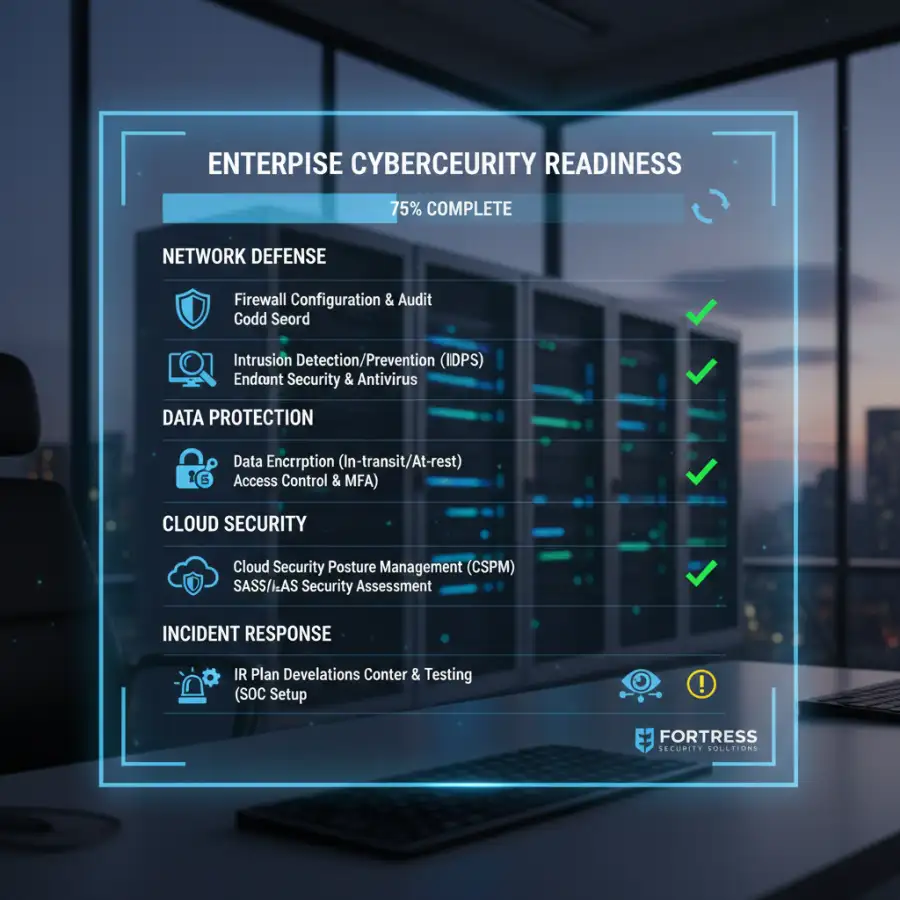
- Implementing the Checklist: Actionable Steps for Robust Enterprise Security
- Navigating Regulatory Compliance: FINRA, GDPR, and Beyond
- What this means for you
- Risks, Trade-offs, and Blind Spots
- Main Points
Understanding the Modern Threat Landscape
The digital battlefield is in constant flux, evolving with a speed that often outpaces traditional defense mechanisms. Today's enterprises contend with a sophisticated array of threats, far beyond the simple viruses of yesteryear. Ransomware, once a niche concern, now paralyzes global corporations, holding critical data hostage. Phishing attacks have become alarmingly convincing, weaponizing human trust to breach even the most fortified perimeters. Supply chain vulnerabilities expose businesses through their vendors, while zero-day exploits lurk, ready to be unleashed before patches can be developed.
The notion of a secure 'perimeter' around a network has largely dissolved, replaced by a porous, distributed environment encompassing cloud services, remote workforces, and countless interconnected devices. Relying solely on firewalls and antivirus software is akin to building a castle wall in an age of air travel; it simply doesn't address the full spectrum of attack vectors. Instead, modern enterprises require a proactive, adaptive defense strategy that anticipates threats rather than merely reacting to them. But how does one even begin to grasp the full scope of these hidden digital dangers?
Building Your Foundation: Core Security Principles for Enterprises
Establishing a strong cybersecurity posture for an enterprise begins with foundational principles, not just a collection of tools. At the forefront is the Zero Trust architecture, a fundamental change that demands verification from every user and device attempting to access resources, regardless of their location inside or outside the network. No implicit trust is granted, ever. Complementing this is the principle of Least Privilege, ensuring that users and systems are granted only the minimum access necessary to perform their specific tasks, severely limiting potential damage from a compromise.
Defense in Depth layers multiple security controls throughout an IT infrastructure, meaning that if one defense fails, others are there to catch it. Think of it as a series of obstacles, each designed to deter an attacker. Strong multi-factor authentication (MFA) moves beyond simple passwords, requiring two or more verification factors, making unauthorized access significantly harder. Comprehensive data encryption, both at rest (on servers, databases) and in transit (over networks), scrambles sensitive information, rendering it useless to unauthorized parties. Finally, robust Identity and Access Management (IAM) systems centralize control over who has access to what, when, and how, providing granular oversight and audit trails. Without these fundamental pillars, can any enterprise truly consider itself resilient?
Implementing the Checklist: Actionable Steps for Robust Enterprise Security
Translating cybersecurity principles into practical, actionable steps is where a comprehensive checklist proves invaluable. Begin with a thorough risk assessment and management program, systematically identifying, analyzing, and prioritizing potential threats and vulnerabilities unique to your enterprise. This isn't a one-time event; it's an ongoing process. Develop a detailed incident response plan, complete with clear roles, communication protocols, and regular simulated drills. When, not if, a breach occurs, a well-rehearsed plan can mean the difference between minor disruption and catastrophic failure.
Employee training and awareness are essential. Humans remain the weakest link in many security chains, making continuous education on phishing, social engineering, and secure practices crucial. Implement thorough patch management and vulnerability scanning routines to identify and remediate weaknesses in software and systems before attackers can exploit them. Network segmentation isolates different parts of your network, containing potential breaches and limiting their spread. Crucially, invest in resilient data backup and disaster recovery strategies; in a worst-case scenario, the ability to restore operations from clean backups is your ultimate safety net. Furthermore, as enterprises increasingly rely on external services, ensuring the security of these third-party integrations is vital. This often involves specific practices for mastering cloud security for enterprise SaaS platforms, which often carry their own unique security considerations and compliance requirements. Are your current safeguards truly sufficient to weather the storm of a determined cyber adversary?
Navigating Regulatory Compliance: FINRA, GDPR, and Beyond
For many enterprises, cybersecurity isn't just about preventing attacks; it's about adherence to a complex web of industry-specific and global regulatory compliance frameworks. Regulations like FINRA in the financial sector, GDPR for data privacy in Europe, HIPAA for healthcare information in the US, and international standards such as ISO 27001, mandate stringent security controls and reporting requirements. Failing to comply can result in severe penalties, reputational damage, and loss of consumer trust.
Establishing a robust Governance, Risk, and Compliance (GRC) program is essential. This involves regularly conducting internal audits to assess your current standing against relevant regulations, identifying gaps, and implementing corrective actions. Preparing for external certifications and third-party audits isn't just about ticking boxes; it's about demonstrating due diligence and a verifiable commitment to protecting sensitive data. By embedding compliance into your cybersecurity strategy, you not only mitigate legal and financial risks but also build a reputation for integrity and reliability. Can your enterprise confidently navigate the complex global data regulations and prove its commitment to data stewardship?

What this means for you
Embracing a proactive and comprehensive cybersecurity strategy fundamentally changes an enterprise's operational landscape. The immediate and most tangible benefit is a significant reduction in financial losses stemming from breaches, which can include significant fines, recovery costs, legal fees, and intellectual property theft. Beyond the balance sheet, a strong cybersecurity posture dramatically enhances brand reputation, positioning your business as a trustworthy custodian of data and services. This, in turn, improves customer loyalty and strengthens stakeholder confidence, critical assets in a competitive marketplace.
Furthermore, robust cyber defenses ensure business continuity, minimizing downtime and operational disruptions in the face of an attack. It moves cybersecurity from a burdensome cost center to a strategic investment, yielding a clear competitive advantage by differentiating your enterprise as secure and reliable. Understanding the true ROI of cybersecurity investments is paramount, demonstrating that these expenditures are not merely expenses but vital contributions to long-term profitability and resilience. Are you truly making the most of the strategic advantages that advanced cybersecurity can offer?
Risks, Trade-offs, and Blind Spots
Even with the most carefully crafted checklist, enterprise cybersecurity is rarely a perfect science. Significant challenges and often overlooked areas remain. Budget constraints frequently force difficult trade-offs, where critical investments might be delayed or scaled back. The shortage of skilled cybersecurity professionals means enterprises often struggle to recruit and retain the talent needed to implement and manage sophisticated security systems. There's also the dangerous trap of over-reliance on technology without adequate human oversight; a tool is only as effective as the person wielding it.
The human element itself remains a persistent vulnerability, with insider threats, accidental errors, and susceptibility to social engineering continuing to pose significant risks. Integrating advanced security measures into complex, often decades-old legacy systems presents another significant challenge, sometimes requiring creative solutions that themselves introduce new points of failure. It's crucial to acknowledge that perfect security is an illusion; the goal is to build an adaptable, resilient system that can detect, respond to, and recover from incidents, accepting that some level of risk will always remain. But are you sufficiently aware of the subtle blind spots that could undermine your entire defense?
Main Points
- Adaptive Defense is Key: Traditional perimeter security is outdated; enterprises need proactive, adaptive strategies to counter evolving threats.
- Foundational Principles Matter: Zero Trust, Least Privilege, Defense in Depth, strong MFA, and comprehensive encryption form the bedrock of enterprise security.
- Actionable Steps are Essential: Implement continuous risk assessments, robust incident response plans, ongoing employee training, diligent patch management, and resilient data backup.
- SaaS Security is Critical: Secure all third-party and cloud-based applications, as they represent significant attack vectors for modern enterprises.
- Compliance is Non-Negotiable: Adhere to regulatory frameworks like FINRA, GDPR, and HIPAA through internal audits and strong GRC programs to mitigate legal and reputational risks.
- Strategic Investment: Cybersecurity offers clear benefits, including reduced financial losses, enhanced brand reputation, business continuity, and a competitive advantage, making it a vital ROI-driven expenditure.
- Acknowledge Limitations: Be aware of budget constraints, skill shortages, human error, and legacy system complexities, understanding that perfect security is unattainable, but resilience is achievable.
This ultimate cybersecurity checklist provides the framework, but the true strength of your enterprise's digital defenses lies in consistent application and a commitment to continuous improvement. Start today to review, reinforce, and refine your cybersecurity posture, ensuring your digital frontier is not just protected, but truly fortified for the future.