
How to Choose the Right Cloud Provider: A Detailed Comparison
Navigating the cloud landscape and selecting the best fit for your needs.
The cloud is now essential for modern business. It offers scalability, flexibility, and cost savings. But with many providers, how do you choose?
This is not just picking a name. It is about understanding your needs and finding a partner to help you grow. Are you ready?
This guide will help you. It compares the leading providers and gives you the information to make a good decision.
Choosing a cloud provider is important for any business today. Many options exist. Picking the right one can be difficult. This article gives a comparison to help you find the best cloud provider for your needs. It focuses on features, cost, security, and scalability. Understanding these factors is key to using cloud computing well. The rise of FinTech has increased the need for reliable cloud solutions.
Quick navigation
- Understanding Your Needs: The Foundation
- Leading Cloud Providers: A Comparative Overview
- Features Comparison: What to Look For
- Cost Analysis: Budgeting for the Cloud
- Security Considerations: Protecting Your Data
- Scalability and Performance: Meeting Future Demands
- What this means for you
- Risks, trade-offs, and blind spots
- Main points
Understanding Your Needs: The Foundation
Before you compare cloud providers, define your needs. What are your main goals for using the cloud? Do you want to reduce IT costs, improve scalability, or improve security? Understanding your needs will guide your evaluation.
Consider these questions:
- Workload Type: What applications and services will you run? For example, web applications, databases, or machine learning.
- Data Storage and Processing: How much data do you need to store and process? What are your data processing requirements?
- Compliance and Regulatory Requirements: Do you need to follow specific industry rules or standards?
- Team Skills and Expertise: What skills does your team have? How much support will you need from the provider?
Answering these questions will help you choose the right cloud provider.
Leading Cloud Providers: A Comparative Overview
The cloud market has a few key players. Each offers different services and features. Here are the most well-known cloud providers:
- Amazon Web Services (AWS): The leader. It offers many services, including compute, storage, databases, and machine learning.
- Microsoft Azure: A strong choice. It works well with Microsoft products, which is good if you use them.
- Google Cloud Platform (GCP): Focuses on data analytics, machine learning, and containerization.
- IBM Cloud: Offers a hybrid cloud approach. It is strong in enterprise solutions and focuses on security and data control.
- Oracle Cloud: Provides various services. It focuses on database management and enterprise applications.
Which provider has the best global presence? Which cloud vendor has the most competitive prices?
Features Comparison: What to Look For
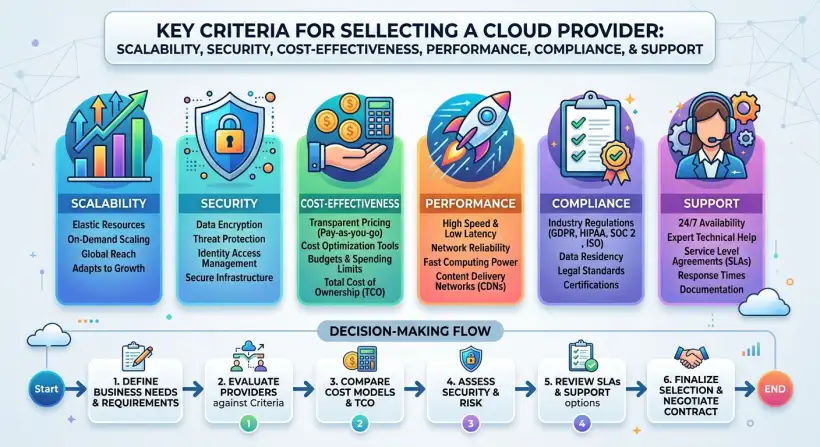
Each cloud provider offers unique features. It is important to assess these features based on your needs. Consider these areas:
- Compute Services: Virtual machines, containers, and serverless computing.
- Storage Services: Object storage, block storage, and file storage.
- Database Services: Relational databases, NoSQL databases, and data warehousing.
- Networking: Virtual private clouds, content delivery networks, and load balancing.
- Machine Learning and AI: Services for data analysis, machine learning, and AI development.
- Developer Tools: Integrated development environments, DevOps tools, and APIs.
Does your business need a lot of compute power? Or are you looking for a storage solution? Understanding these aspects will help you.
Cost Analysis: Budgeting for the Cloud
Cloud costs vary based on use, services, and pricing models. Understanding the cost structures of each provider is important for budgeting.
- Pricing Models: Pay-as-you-go, reserved instances, spot instances, and committed use discounts.
- Cost Optimization Tools: Tools that help you monitor and manage cloud spending.
- Total Cost of Ownership (TCO): Consider all costs, including compute, storage, networking, and data transfer.
- Vendor Lock-in: Be aware of vendor lock-in and the cost of moving data and applications.
Is the cost structure clear and predictable? Does the provider offer ways to save money?
Security Considerations: Protecting Your Data
Security is very important when choosing a cloud provider. Providers offer security features, but you and the provider share responsibility.
- Data Encryption: Encrypting data when it is stored and when it is in transit.
- Identity and Access Management (IAM): Controls for user access and permissions.
- Compliance Certifications: Following industry standards and regulations.
- Disaster Recovery and Business Continuity: Solutions for data backup, recovery, and business continuity.
- Security Monitoring and Threat Detection: Tools for finding and stopping security threats.
What security measures are in place to protect your data? What compliance certifications does the provider offer?
Scalability and Performance: Meeting Future Demands
Scalability and performance are important. They ensure your cloud environment can handle more work and user needs.
- Scalability Options: Horizontal and vertical scaling.
- Performance Metrics: Monitoring and measuring performance, such as latency, throughput, and uptime.
- Global Presence: Data centers in different regions for better performance and availability.
- Content Delivery Networks (CDNs): Using CDNs to deliver content quickly.
Does the provider offer the scalability you need for future growth? Can the provider handle peak loads and traffic spikes?
What this means for you
Choosing the right cloud provider is a strategic decision. It can greatly impact your business success. You can make a good decision by assessing your needs and comparing providers. Consider features, cost, security, and scalability.
Remember to consider your current infrastructure, your team's skills, and your long-term plans. Try different providers with pilot projects to find the best fit.
Risks, trade-offs, and blind spots
Choosing a cloud provider has risks and trade-offs. One risk is vendor lock-in. Moving data and applications between providers can be complex and costly. Another trade-off is the learning curve. New providers require time to learn and optimize your cloud resources.
Failing to anticipate future costs and scalability requirements is another blind spot. Staying informed about the latest cloud technologies is important to avoid these problems.
Main points
- Define Your Needs First: Know your requirements, workloads, and compliance needs before evaluating providers.
- Compare Key Features: Evaluate features like compute, storage, databases, networking, and machine learning.
- Analyze Cost Structures: Compare pricing models, cost optimization tools, and the total cost of ownership.
- Prioritize Security: Assess security measures, data encryption, IAM, compliance certifications, and disaster recovery.
- Consider Scalability and Performance: Evaluate scalability, performance metrics, global presence, and CDNs.
- Understand Risks: Be aware of vendor lock-in, the learning curve, and cloud management complexity.
- Leverage Pilot Projects: Try multiple providers with pilot projects to find the best fit.
- Stay Informed: Keep up-to-date with the latest cloud technologies.
Follow this guide to choose a cloud provider that helps you meet your business goals. Ensure the provider offers the support and expertise your team needs.