
What Is Identity and Access Management? A Comprehensive Guide
Understanding IAM in the Context of Cybersecurity
In today's interconnected world, protecting digital assets is more critical than ever. How do you ensure the right people access the right resources without security threats?
Identity and Access Management (IAM) is the cybersecurity hero. It decides who gets in, what they can do, and how their actions are watched.
This guide goes in-depth on IAM. It offers a complete overview of its principles, components, and real-world uses. You will gain a strong understanding of IAM and its role in protecting your digital world.
Identity and Access Management (IAM) is a key part of cybersecurity. It protects sensitive data and resources. IAM is a set of policies and technologies. They ensure the right people access the right resources at the right time. This guide explores the essential parts of IAM. You will understand its importance and how it works.
Quick navigation
What Is Identity and Access Management?
Identity and Access Management (IAM) manages digital identities and access rights. It uses business processes, policies, and technologies. IAM makes sure only authorized users can access specific resources. These resources include applications, data, and systems. IAM is a key part of cybersecurity. It helps organizations lower the risk of data breaches. It also helps them follow rules and improve efficiency. IAM solutions act as a digital gatekeeper. They check user identities and control access to information and systems.
Why is IAM so important? Data breaches are common and sophisticated. IAM offers a strong defense against unauthorized access. It lets organizations:
- Protect Sensitive Data: IAM controls who accesses data. This helps prevent data breaches and loss.
- Ensure Regulatory Compliance: IAM helps organizations meet rules like GDPR and HIPAA. It controls access to protected information.
- Improve Operational Efficiency: IAM automates many access management tasks. This reduces the work for IT staff and improves user experience.
IAM is not just a technical solution. It is a strategic way to manage digital identities and access rights. It is the foundation for secure and compliant operations. Think of it as the central nervous system for your digital security. It controls access to all your important assets.
Key Components of IAM
IAM is a complex system. It has several key components that work together for secure access. Understanding these components is important to understand IAM fully. What are the key elements of an effective IAM system?
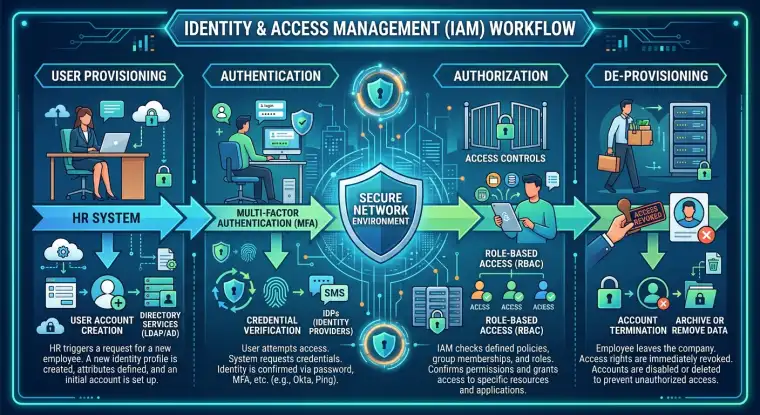
- Identity Management: This involves creating, managing, and maintaining digital identities. It includes user provisioning, deprovisioning, and identity lifecycle management. Identity management makes sure user identities are accurate and up-to-date across all systems.
- Authentication: Authentication checks a user's identity. It uses methods like passwords, multi-factor authentication (MFA), and biometrics. Strong authentication prevents unauthorized access.
- Authorization: Authorization defines what a user can access and do after they are authenticated. It assigns permissions and privileges based on roles, groups, and other attributes. Authorization makes sure users only access the resources they need.
- Access Governance: This involves monitoring, auditing, and reporting on access controls. It makes sure access rights are managed correctly. It also identifies and fixes any policy issues. Access governance provides visibility and accountability in the IAM system.
- Directory Services: Directory services store and manage identity information. They provide a central repository for user profiles, roles, and permissions. Microsoft Active Directory and LDAP are examples of directory services.
These components work together to provide a complete IAM solution. They secure digital assets and ensure compliance. Organizations can lower their risk and improve security by using a well-designed IAM system.
How IAM Works
An IAM system uses connected processes. It is a system designed to manage identities and access securely. How does this system work?
The process starts by creating a digital identity. This often happens through user registration or provisioning. The user then tries to access a resource or system. The IAM system authenticates the user. It checks their identity using passwords, MFA, or biometric scans. The system authorizes the user after successful authentication. It decides which resources they can access based on their roles, groups, and permissions. This process is often role-based access control (RBAC). RBAC simplifies access management by assigning permissions to roles instead of individual users.
IAM systems also monitor and audit. They track user access, identify unusual activity, and create reports. This ensures compliance and security. This continuous monitoring helps organizations find and fix potential threats quickly. IAM solutions also automate tasks like password resets and access requests. They also automate deprovisioning users who leave the organization. This improves efficiency and reduces errors.
Common IAM Frameworks
IAM systems use frameworks and standards. These frameworks give organizations a structure to follow. This ensures IAM solutions are complete, secure, and compliant. Which IAM frameworks should you know?
- Role-Based Access Control (RBAC): This framework assigns permissions based on user roles. It simplifies access management and reduces administrative work.
- Attribute-Based Access Control (ABAC): This approach uses attributes of the user, resource, and environment to determine access. It offers more flexibility and control.
- Federated Identity Management (FIM): Users can access multiple resources with one set of credentials. This is common in cloud environments. It allows easy access across different systems.
- Zero Trust: This security model assumes no user or device is trustworthy. It requires continuous verification before granting access. This is important in modern cybersecurity.
These frameworks help organizations design and implement IAM solutions. These solutions meet their specific needs and security requirements. Organizations can create strong and effective IAM systems by using these frameworks. They can protect their digital assets.
IAM Tools and Solutions
Many tools and solutions are available to implement IAM. These tools offer features from user provisioning to access governance. What are the main types of tools used in IAM?
- User Provisioning Systems: These automate the creation, modification, and deletion of user accounts. They work across different systems.
- Multi-Factor Authentication (MFA): This adds extra security. It requires users to provide multiple forms of authentication.
- Privileged Access Management (PAM): This manages and secures access to privileged accounts. These accounts are used by administrators.
- Single Sign-On (SSO): Users can access multiple applications with one set of credentials.
- Access Governance Tools: These monitor and manage access rights. They ensure compliance with policies and regulations.
The right tools and solutions depend on an organization's needs, budget, and security requirements. Using these tools correctly can improve an organization's IAM capabilities. You can explore how these tools improve financial technology in FinTech.
What this means for you
IAM affects everyone in an organization, not just IT. It affects how employees access resources, how data is protected, and how the organization follows rules. How does IAM affect you?
IAM ensures employees have secure and efficient access to the tools and data they need. It simplifies the login process and reduces passwords. However, your access is controlled, and any suspicious activity is watched. IAM protects your data and prevents unauthorized access to your information. You might use IAM solutions every day without realizing it.
IAM offers benefits to IT staff. These benefits include automation and centralized management. It simplifies user provisioning, reduces manual tasks, and improves efficiency. IAM provides strong security controls. It helps IT staff prevent data breaches and maintain compliance. IAM solutions reduce the risk of insider threats.
Risks, trade-offs, and blind spots
You must understand the risks, trade-offs, and potential blind spots of IAM. What are the challenges of implementing and managing IAM?
One major risk is the complexity of implementation and management. IAM systems can be complex. They need expertise and resources to configure and maintain. Another challenge is user frustration. If IAM systems are poorly designed, they can cause login issues and reduce productivity. Organizations can become dependent on a single vendor for IAM solutions. This is called vendor lock-in.
Trade-offs often involve balancing security and usability. Strong security measures can make it difficult for users to access resources. This impacts productivity. Organizations must consider these trade-offs and implement IAM solutions that balance security and user experience. Blind spots might include incorrect access controls or inadequate monitoring. This can create vulnerabilities that attackers could use. Regular audits, training, and threat monitoring are essential to reduce these risks.
Main points
IAM is a way to secure digital assets. It ensures only authorized users access the right resources. IAM includes identity management, authentication, authorization, and access governance. What are the main points of this guide?
- IAM protects sensitive data and resources.
- IAM manages digital identities and access rights.
- IAM helps with compliance and operational efficiency.
- Key components include identity management, authentication, authorization, access governance, and directory services.
- IAM uses frameworks like RBAC, ABAC, FIM, and Zero Trust.
- IAM uses tools like user provisioning, MFA, PAM, SSO, and access governance tools.
- IAM affects everyone in an organization, from employees to IT staff.
- Successfully implemented IAM improves cybersecurity and business operations.
You can better protect your data and systems by understanding IAM. Do you want to learn how to navigate digital environments? Explore how to navigate digital campuses in Navigating Digital Campuses. You can investigate licensing and security to learn more about security.